By Fatima Salinas, Marketing Assistant, College of Liberal Arts and Sciences
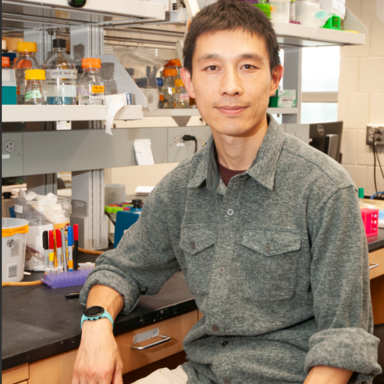
Bin Z. He
Associate Professor
Biology
What is the focus of your work?
The long-term goal of our lab is to understand the genomic adaptation behind the multiple origins of human fungal pathogens—pathogenic fungi, including yeast pathogens, emerged multiple times in evolution and novel pathogens continue to arise, posing a great threat to human health. We approach this question from an evolutionary angle, focusing on two features: divergence in stress-response gene regulatory network, and adhesin gene-family expansion.
Tell us about the broad impact you’d like it to have.
I aim to make broad impacts on three areas with our research and outreach. First, we would like to identify shared genomic changes behind the repeated emergence of human fungal pathogens, thereby offering new biological targets for the prevention and treatment of fungal infections. Second, we aim at using stress response as a model to uncover general principles about the evolution of gene regulatory networks, which are a major driver for generating biodiversity. Lastly, I aim to use the courses I teach in CLAS (College of Liberal Arts and Sciences) and summer coding workshops as pioneering efforts to enhance computational skills for Biology and related majors.
What excites you about the environment in CLAS (College of Liberal Arts and Sciences)?
The interdisciplinary nature and the shared passion for excellence in educating our students while excelling in research.
What are your hobbies and pursuits outside of work?
I enjoy running. I'm a regular participant in the Iowa City Park run; a free, volunteer-run weekly 5k. We have a lot of colleagues, including those from CLAS, in the group!
What are your favorite things to do in the Iowa City area?
Visit Prairie Lights Cafe and browse the books, enjoy the locally sourced food from New Pi Co-op, and take advantage of the great trail system for running and biking.