The 2026 Summer Scientific Coding Workshop (SciCoW) introduced college students with little or no previous programming experience to Python and showed how coding can be used to address biological research questions.
The four-week workshop, held remotely from July 13 to August 6, combined self-paced lessons from an online course with live instruction, team-based work sessions, coding challenges, reflective journals, and discussions with scientists and professionals who use computational skills in their careers. The workshop was directed by Bin Z. He, Associate Professor in the University of Iowa Department of Biology, and taught with Biology graduate student, Hubert Kicinski. The program was supported by the National Science Foundation.
Thirty students were accepted into the program from the University of Iowa and other institutions, including six students from Grinnell College and 16 first-generation college students.
The workshop featured three invited speakers who demonstrated different ways that biology and computational skills can intersect professionally. Courtney Ries, a University of Iowa biology graduate and participant in the 2021 SciCoW pilot, discussed how her biology and programming background contributed to her current work at Corteva Agriscience. Muhammad Elsadany, a recent graduate of Iowa's Genetics PhD program and now a scientist at Regeneron, described his path from learning programming as an undergraduate to working in computational genomics. Erik Krohn, Professor of Instruction in the Department of Computer Science at Iowa, discussed how artificial intelligence is changing computer science and programming education.
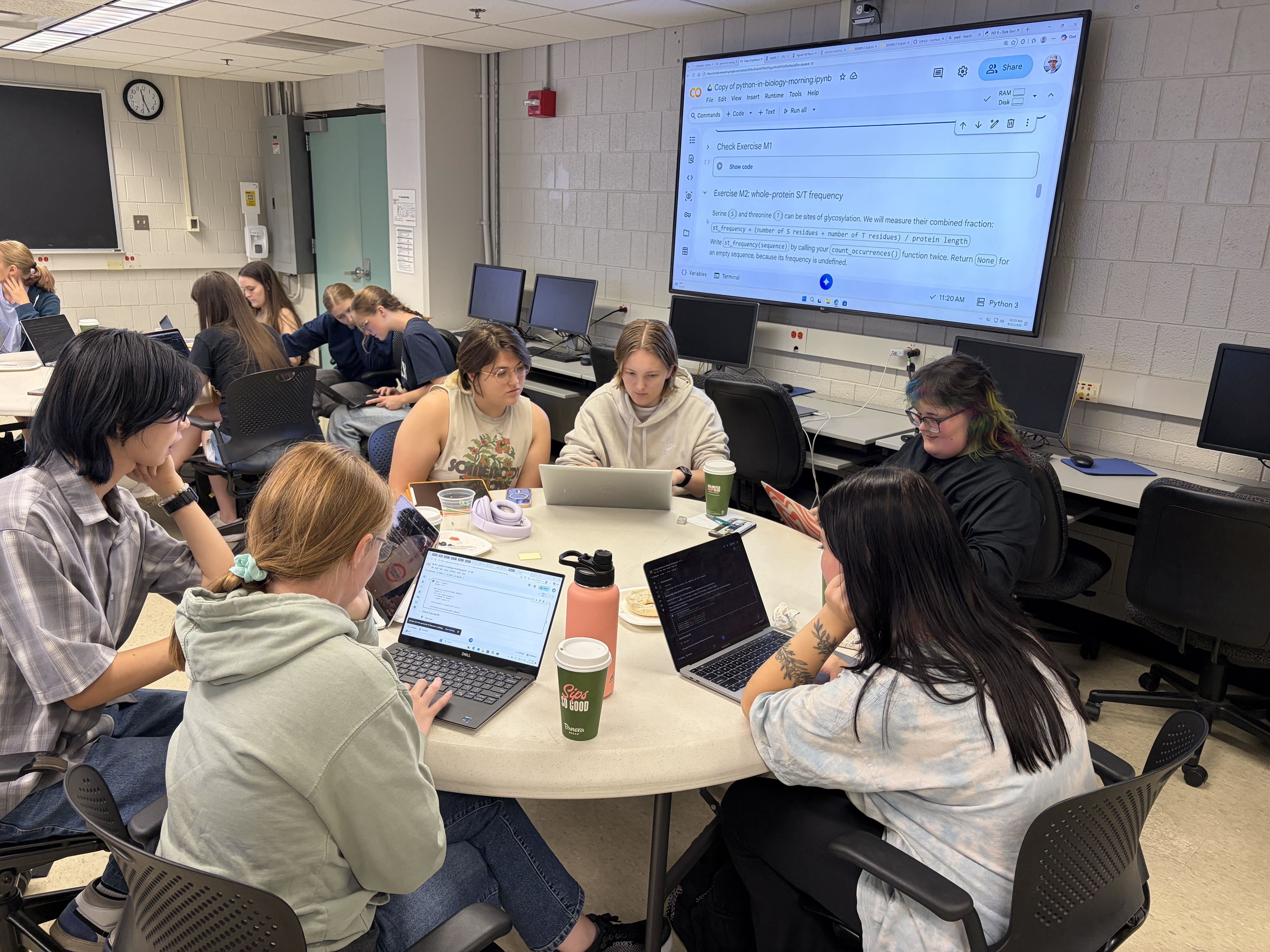
On August 12, nine workshop participants joined three students from He's research lab for an optional in-person capstone. Students applied the programming concepts they had learned to an ongoing research problem in the He laboratory: predicting fungal cell-surface adhesin proteins from their amino acid sequences. Working in two teams, students wrote Python functions to analyze protein sequences, including calculating the frequencies of serine and threonine, features commonly associated with fungal adhesins.
The program will continue in Summer 2027. For more information about the program, visit scicow.binhe.org.